Walking instruction / at your pace
Find your feet. Take the next step.
How to start, move forward, stop and turn. Watch each movement, break it into positions, then rehearse one useful cue at a time.
Start the walking lessonConnected movement. Comfortable steps.
The main lesson is for people already able and cleared to walk independently on level ground. If you need a device, hands-on help or have weight-bearing restrictions, follow your therapist’s plan and use the walking-aid reminders. This page does not assess fall risk or clear you to walk.
01 / Learn the movement
One task.
A few clear cues.
Read the instruction, watch the slow demonstration, then pause at any position. Animation speed is for viewing, not a walking target.
Side viewSimplified movement
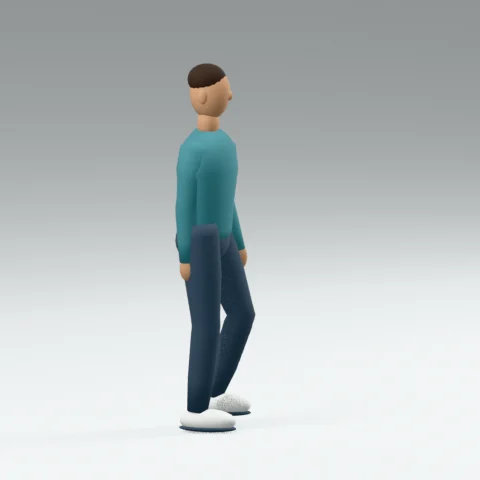
Lesson 1 of 5
Set up a clear, comfortable start.
- Choose a clear, level route with room to stop and turn.
- Wear secure shoes. Stand in a comfortable base with both feet supported.
- Look along the route, relax your shoulders and breathe normally.
Notice thisYou feel steady before the first step.
Use these cues as options. Your gait may differ after injury, surgery or a neurological condition. Do not force a particular stride or foot strike.
Breathing and pace
Keep breathing while you walk. Choose a pace at which you can speak comfortably for this rehearsal. There is no need to match one breath to each step.
A useful cue, not a perfect-looking walk
Focus on one thing, such as clearing your toes or taking smaller turning steps. Do not chase a longer stride or symmetry if it increases pain or makes you less steady.
02 / If you use support
Your device.
Your prescribed plan.
These are reminders for a device already selected and fitted by your care team. Do not switch devices or change how much weight you put on a leg based on this page.
Do not use a walker on stairs or escalators. Stairs, curbs, freezing, foot drop and restricted weight bearing need individualized instruction. A cane is not a substitute for adequate support when you cannot load a leg. AAOS walking-aid guide
03 / Take it off the screen
One small
rehearsal.
Read first, then put the phone aside. On a familiar, level route, try a short comfortable walk with room to slow down and turn. Use your usual prescribed support. Keep any help your care team recommends.
This is a sequence to rehearse, not a timed workout or a test of independence. Increase distance gradually only when comfortable and consistent with your plan.
0 of 4 reminders checked. This is not a safety score.
Self-check · 1 of 3
Walk well / practical reminder
Your walking sequence.
- Prepare: clear a level route, wear secure shoes and use your prescribed support.
- Start: settle your balance, then take a comfortable first step. Avoid reaching far ahead with your foot.
- Continue: let your body move forward as one foot supports you and the other clears the floor. Keep breathing.
- Stop: slow down and shorten your last steps. Finish with a comfortable base before changing tasks.
- Turn: use small steps around a curve. Avoid crossing your feet or spinning on one planted foot.
Keep it individual: no fixed step length, speed or foot-strike pattern suits everyone. Follow restrictions and device instructions from your care team.
Stop practice for dizziness, increasing pain, unusual breathlessness or loss of balance. New or worsening weakness, toe dragging or repeated falls need assessment. Sudden one-sided weakness, facial droop or speech difficulty, fainting, chest pain or severe breathing difficulty need emergency help.
DMC Hub · Walk well · General patient education, September 2026. NHS walking guidance and AAOS walking-aid guidance. This sheet is not individual clearance to walk.
If the foot keeps catching
Do not keep forcing a larger step to compensate. Ask a clinician or physical therapist to assess the cause and whether a device, brace or different strategy is needed.
If turning feels unsteady
Use your prescribed support and seek individualized help. This guide does not ask you to practice on one leg, close your eyes or deliberately challenge your balance.
Sources, scope and illustration notes
The main lesson illustrates comfortable level walking for someone already walking independently. Figures are simplified teaching models, not motion capture or gait assessment. Playback is deliberately slow. Device reminders do not apply to every prescription.
- NHS: Walking for health · footwear, gradual progression and activity guidance.
- AAOS: Canes, crutches and walkers · device positioning and sequencing.
- NHS: Foot drop · assessment for difficulty lifting the foot or toes.
- NHS: Stroke symptoms · sudden neurological symptoms.
For personalized gait rehabilitation, ask your physical therapist. General education reviewed September 2026.